中意
- 4.1
- Rating
- 100.00K
- Installs
- Free
- Price

 Analysis by App-foxy
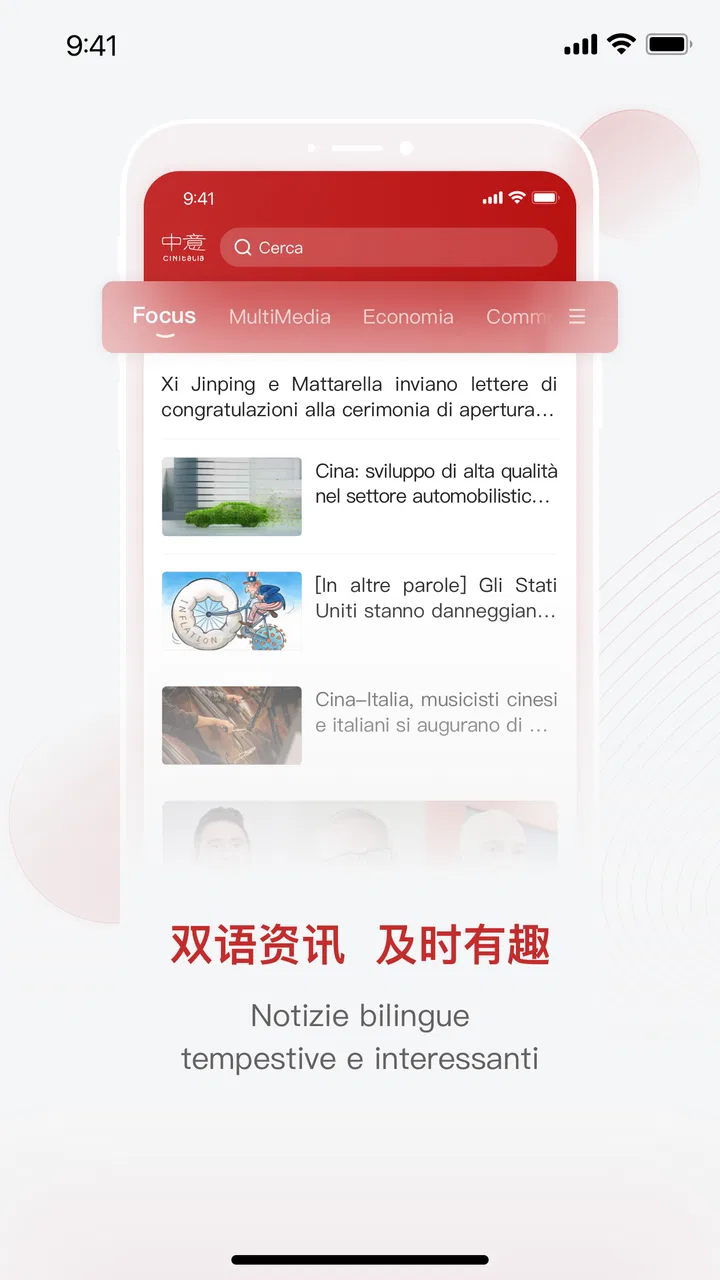
I approached 中意 as a reader looking for a bridge between Chinese and Italian perspectives rather than as a general-purpose breaking-news app. That distinction matters. This is a free News & Magazines app from China Global Television Network Corp., built around Chinese–Italian bilingual content and cultural exchange. Its subject range reaches food, travel, business, culture, music, film, and television, so the appeal is less about one narrow topic and more about seeing familiar subjects through two connected cultural viewpoints.
My overall impression is that it makes the most sense for people who regularly move between Chinese and Italian language or culture. It can also suit a curious reader who wants a compact way to explore links between the two countries. However, I would not treat it as a replacement for every newspaper, translator, or specialist travel guide. Its value comes from the combination of language and cultural context, not from trying to cover every kind of news with the same depth.
What the bilingual focus feels like in everyday use
The central idea is easy to understand: instead of separating Chinese and Italian audiences, 中意 places both languages at the heart of the reading experience. That gives the app a more specific identity than a standard magazine feed. I can imagine using it when preparing for a trip, following cultural stories, comparing how a topic is presented across languages, or simply keeping a connection with a second language without opening several unrelated apps.
You May Also Like

 Blood Strike: 2.5 Anniversary
Blood Strike’s Loadouts Turn Every Drop Into a Tactical Gamble
A close look at Blood Strike’s custom loadouts: how fast access to signature weapons reshapes its battle royale rhythm, rewards preparation, and narrows the gap between fights.

 Pandora - Music & Podcasts
Pandora’s Music Is Easy to Start, but Harder to Recover
Pandora’s strength is its low-effort path from a seed to a station. Its weak spot is how much confidence it asks you to place in connection, setup, and quiet recovery.

 8 Ball Pool
 Is Built on Rivalries, Rematches, and Routine
A close look at the rivalries, rematches, shared routines, and unanswered safety questions that turn a quick pool match into a persistent mobile community.

 Samsung Music
’s Quiet Strength Is Playing What You Already Own
Its reach comes less from spectacle than from dependable access to a personal library. That simplicity is both the app’s strongest retention engine and its ceiling.

 AccuWeather: Weather Radar
AccuWeather Review: A Quick, Clear Forecast for Everyday Decisions
For everyday plans, the best forecast is the one you can understand quickly. AccuWeather makes rain timing, radar, and local conditions easy to act on, with a few trade-offs.

 Hill Climb Racing
Why Hill Climb Racing Still Turns Crashes Into One More Run
A tiny car, a bumpy hill and one more upgrade: Hill Climb Racing keeps resurfacing because its simple chaos makes every near-miss feel personal.
More From Our News Desk
View All News


The content areas also make the app approachable. Food and tourism offer an easy starting point because they are practical and visual subjects. Economy and culture are more useful when I want context about how the two countries interact. Music, film, and television give the app a lighter side, especially for readers who are interested in entertainment as a way to discover language and everyday references.
That mix creates a useful trade-off. A broad selection keeps the app from feeling too narrow, but it also means someone searching for highly specialized financial reporting or detailed local travel instructions may need another source. I would use it to discover themes and stories, then move to a specialist publication when I need technical depth, official guidance, or extensive local detail.
One practical advantage of a bilingual publication is that it can support different reading habits within the same household or group of friends. An Italian speaker and a Chinese speaker can approach the same cultural space from their own language background. For language learners, the app may also work as a prompt for comparing expressions and ideas, although I would still use a dedicated language-learning tool for structured lessons, exercises, and progress tracking.
Where I would use it during a normal day
Imagine planning an evening around an Italian film, checking ideas for a future trip, and wanting a little more background on the food or cultural setting connected with it. I would open 中意 for discovery rather than immediately searching the wider web. The app’s subject mix makes that kind of browsing feel natural: one story can lead to another without requiring me to decide in advance whether I want news, travel, or entertainment.
Another realistic use is language maintenance. Someone who has studied Italian but rarely uses it could browse a familiar topic, such as cuisine or music, and use the bilingual setting to stay engaged. The important point is to read actively rather than treating the app as an automatic translation service. I would compare wording only when the presentation makes that convenient, and I would avoid assuming that every cultural nuance can be understood by matching sentences word for word.
For a person working with Chinese–Italian cultural projects, the app may be more relevant than a broad international news reader because its editorial direction is already focused on the relationship between the two countries. That focus can save time when the goal is cultural orientation. On the other hand, a reader who wants worldwide coverage across many regions will probably find a larger international news app more efficient.
Speed expectations and the feel of browsing
I would set moderate expectations for speed. 中意 is a content-focused app, so the experience depends not only on the app itself but also on how quickly articles and media are delivered. Short browsing sessions should feel straightforward on a reasonably modern device, while image-heavy or media-rich pages may naturally take longer to become comfortable to read. I would not judge it solely by the first screen; the real test is whether moving from one cultural topic to another remains convenient.
The current Android version is 4.8.0.google, and it supports devices running Android 6.0 or later. That relatively broad operating-system reach is useful for people who do not own a recent phone, but it also means the experience can vary noticeably between an older handset and a newer one. On an older device, I would keep expectations realistic when opening several content pages in succession, especially if other apps are active at the same time.
A useful browsing habit is to decide what kind of session I want before opening the app. For a quick check, I would choose one section and read a small number of items instead of repeatedly jumping across every topic. For a longer session, I would allow more time for pages to settle and focus on the stories that genuinely connect with my interests. This is not a hidden setting; it is simply the best way to get value from a broad bilingual catalogue without turning the experience into aimless scrolling.
The app’s strength is discovery, so speed should be judged by how quickly I can reach something meaningful, not just by how quickly a list appears. If I need an immediate headline scan, a dedicated breaking-news service may feel more direct. If I want to wander through food, tourism, culture, and entertainment with a Chinese–Italian connection, a little more browsing is part of the point.
What happens during heavier reading sessions
Longer sessions are where the app’s wide subject range becomes both useful and demanding. Moving between articles about tourism, economy, and film can create a richer picture of the two countries, but it also asks more from my attention than a single-topic reader would. I would avoid opening many pages at once and would finish or note the important items before continuing. That simple workflow reduces confusion and makes the bilingual material easier to absorb.
Resource demands are also likely to be felt most during media-rich reading rather than during a quick text check. I would be more cautious on a phone with limited storage, memory, or battery, particularly if I were using the app alongside navigation, video, or social applications. I cannot recommend it as a low-resource specialist tool; its content mix is the reason to install it, and richer content can make a session more substantial than a plain headline feed.
For travel planning, I would use it in two stages. First, I would browse it for cultural clues and ideas: foods to investigate, places connected with a story, or entertainment that might add context to a destination. Then I would verify practical details through official tourism or transport sources. This is an important trade-off: the app can help me understand what may be culturally interesting, but it should not be my only source for schedules, entry rules, reservations, or urgent travel decisions.
For students and language learners, heavier use can be more productive if it is deliberate. I would select one topic, read the Chinese or Italian presentation first, and then compare the other language only after forming my own understanding. That approach turns casual browsing into a small study routine. It also exposes a limitation: without structured vocabulary tools, the app cannot replace a course, dictionary, or tutor when I need precise language feedback.
Reliability, recovery, and the limits of a content app
Reliability here is not only about whether the app opens. It is also about whether I can return to the kind of content I wanted, recover from an interrupted session, and trust myself to distinguish cultural reading from practical authority. If I am interrupted by a call or switch to another task, I would expect to spend a moment finding my place again rather than assuming every reading session will resume exactly where I left off.
That is why I would treat the app as a discovery companion, not as an archive for important information. If an article inspires a trip, purchase, academic project, or professional decision, I would record the useful details elsewhere and confirm them with a primary source. This workflow is especially important for economy-related material, where a general cultural platform may be helpful for orientation but not sufficient for decisions involving money or policy.
The developer, China Global Television Network Corp., gives the app a clear media identity. In practical terms, that makes me expect an editorial experience rather than a personal note-taking tool or a community forum. Readers who prefer a focused publication may appreciate that direction. Readers who want extensive customization, collaborative discussion, or a highly personal feed may find the experience less flexible than a general news aggregator.
The listed average rating is 0.0, while the app has passed the 100K-install mark. I would read those figures cautiously rather than treating either one as a complete verdict. The install figure suggests that the app has reached a meaningful audience, but the rating does not give me a useful quality signal. My decision would therefore depend more on whether I genuinely need Chinese–Italian cultural content than on store feedback.
Recovery also depends on how I use it. If I am reading something important, I would save the title or make a brief note before leaving the app. If I am only browsing for ideas, losing my place is less serious. This small distinction separates casual use from research use, and it is one reason I would not rely on the app alone for a detailed project.
Device constraints and who should install it
Because the minimum requirement is Android 6.0, 中意 is accessible to a wide range of Android users. That is helpful for people keeping an older phone, but compatibility does not guarantee identical comfort on every device. Screen size, memory, display quality, and the number of other active applications will affect how pleasant bilingual reading feels. On a compact or aging phone, I would prefer shorter sessions and fewer simultaneous tasks.
The app is free, which lowers the barrier to trying it. It also carries an Everyone age rating, so it is positioned for a broad audience rather than a narrowly adult readership. Parents and younger readers should still use ordinary judgement about which news and cultural topics they explore, but the rating makes the app easier to consider for general household use.
I would recommend installing it if at least one of these situations sounds familiar: I want Chinese–Italian cultural material in one place; I am studying or maintaining one of the two languages; I am interested in food, travel, economy, music, film, or television through a cross-border lens; or I need a starting point for understanding cultural connections. The app is particularly suitable for readers who enjoy browsing and making their own connections between subjects.
I would skip it if my priority is minute-by-minute global breaking news, deep specialist reporting, a complete travel-planning system, or formal language instruction. A general news app will usually be faster for broad headline coverage. A specialist travel service will be better for bookings and logistics. A language-learning platform will offer more structured practice. Choosing one of those alternatives is not a criticism of 中意; it simply reflects a different purpose.
My performance verdict after weighing the trade-offs
My verdict is positive but specific: 中意 is worth trying when the Chinese–Italian connection is the reason I am opening a news and culture app. Its bilingual identity gives it a clear purpose, and the combination of food, tourism, economy, culture, music, film, and television creates useful paths for exploration. I especially like the possibility of using it as a bridge between language practice and cultural discovery rather than treating it as another undifferentiated headline feed.
I would keep my expectations measured on older hardware and during longer, media-heavy sessions. The broad Android compatibility is convenient, but it does not turn an older phone into a fast reading device. I would also build a habit of confirming practical or high-stakes information elsewhere. Those are reasonable precautions for a broad cultural publication and do not undermine its main value.
In the end, I see this as a focused companion for readers with a genuine interest in China and Italy. It is free to try, suitable for Everyone, and developed by China Global Television Network Corp. The release date was January 8, 2020, so I would judge it by how well its current experience serves my needs rather than by assuming that age alone defines its usefulness. If bilingual cultural discovery is your priority, this is a focused option; if you want universal news coverage or specialist tools, choose something built for that job instead.
FAQs for 中意
01What is the main purpose of the 中意 app?
The 中意 app is designed to help users learn and practice the Chinese language in an engaging and interactive way. It offers features such as vocabulary builders, grammar exercises, and conversation simulations to enhance language proficiency. Additionally, it provides cultural insights and tips to deepen understanding of Chinese customs.
02Is 中意 suitable for beginners, or is it more advanced?
中意 is suitable for both beginners and advanced learners. It offers a tiered learning system that allows users to start at their current level and progressively advance. Beginners can start with basic vocabulary and phrases, while more advanced learners can focus on complex sentence structures and cultural nuances.
03Does 中意 require an internet connection to use?
While some features of 中意 require an internet connection, such as live conversation practices and community forums, many essential learning modules can be accessed offline. This makes it convenient for users who want to practice and learn on the go without needing constant connectivity.
04Are there any in-app purchases or subscription fees associated with 中意?
中意 offers a free version with basic features, but to access advanced lessons and exclusive content, users may need to subscribe to a premium plan. The subscription fees are used to continuously update the app with new content and maintain high-quality educational resources.
05How does 中意 ensure effective language learning?
中意 employs a variety of educational methodologies, including spaced repetition for vocabulary retention, interactive quizzes for grammar practice, and real-life conversation scenarios. Additionally, users can track their progress and receive personalized feedback, making the learning experience both effective and tailored to individual needs.
Pros
- User-friendly interface enhances experience.
- Wide range of customization options available.
- Lightweight app
- minimizes battery drain.
- Supports multiple languages for accessibility.
- Seamless integration with other platforms.
Cons
- Limited offline functionality available.
- Occasional ads can disrupt usage.
- Requires frequent updates for stability.
- Some features need a premium subscription.
- Compatibility issues on older devices.

Gallery